
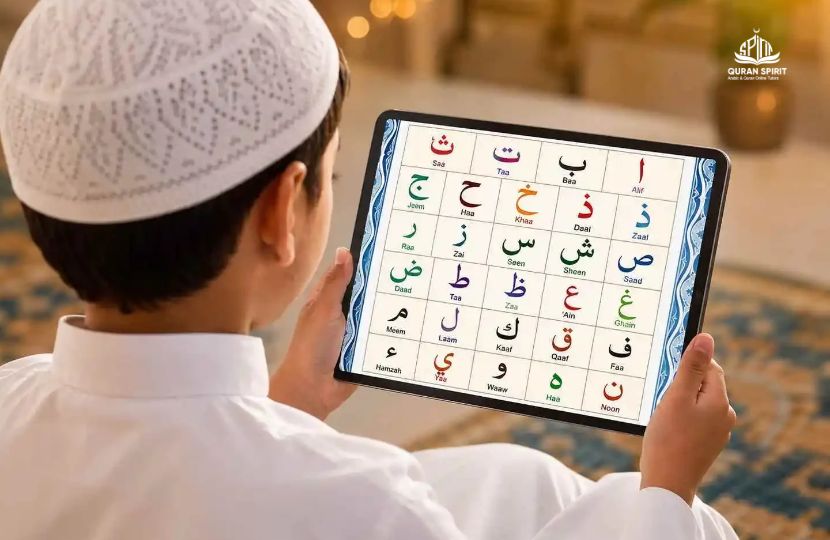
Reading the Holy Quran accurately is usually a difficult task for non-Arabic speakers and beginners. The Arabic language relies on distinct articulation points and subtle phonetic rules that do not exist in many other languages. This is precisely where the Noorani Qaida plays a foundational role.
Whether you are a beginner or looking for structured ways of learning Noorani Qaida for kids, this booklet serves as the ultimate stepping stone toward fluent and beautiful Quranic recitation.
Here is a step-by-step guide by the tutors of Quran Spirit on how Noorani Qaida supports better Quran pronunciation.
8 Ways Noorani Qaida Builds Precise Quran Pronunciation
1. Mastering Individual Arabic Alphabets (Makharij)
The cornerstone of learning Noorani Qaida online is understanding the exact articulation points (Makharij) of all 28 Arabic letters. Arabic contains several throat and tongue sounds—such as Haa (ح), Ayn (ع), and Qaf (ق)—that require specific throat and mouth positioning. Noorani Qaida isolates each letter so beginners learn where sounds originate before combining them into words.
2. Differentiating Similar-Sounding Letters
Many beginners struggle to differentiate between phonetically close letters, such as Ta (ت) versus Taa (ط), or Sin (س) versus Sad (ص). Noorani Qaida systematically pairs and contrasts heavy (Mufakham) and light (Muraqqaq) letters, preventing common mispronunciations that could alter the meaning of Quranic verses.
3. Understanding Short Vowels (Harakat)
Correct pronunciation depends heavily on short vowel marks: Fatha (accents), Kasra, and Damma. Through repeated practice in the early chapters of Noorani Qaida, students develop immediate recognition of these marks, ensuring they do not stretch short vowels into long ones or clip them accidentally.
4. Grasping Long Vowels and Elongation (Madd)
Proper Quranic recitation requires knowing when to elongate a sound and by how many counts. Noorani Qaida introduces the letters of Madd (Alif, Waw, and Ya) in simple, digestible rules. Students learn the mechanics of stretching sounds naturally, laying down the habits needed for advanced Tajweed rules later on.
5. Smooth Transition to Compound Letters (Murakkabat)
Moving from single letters to connected words can be overwhelming. Noorani Qaida introduces Murakkabat (letter combinations), helping students identify how letter shapes alter based on their position—beginning, middle, or end of a word. This visual and phonetic familiarity speeds up reading recognition without compromising accuracy.
6. Correct Application of Sukoon and Shaddah
Vowel-less letters (Sukoon) and doubled letters (Shaddah) dictate the rhythm and emphasis of Quranic words. Noorani Qaida teaches students how to rest on a consonant or apply appropriate emphasis (Nabr) on a doubled letter, which is critical for maintaining proper speech rhythm during recitation.
7. Internalizing Core Tajweed Rules (Nunnation, Tanween & Mim Sakinah)
Before tackling full passages of the Quran, students encounter fundamental Tajweed concepts like Ghunnah (nasal sound), Idgham (merging), and Ikhfa (concealment) within the Qaida exercises. By practicing these rules on simple word pairs, students build muscle memory long before reading full Surahs.
8. Building Reading Stamina and Confidence
Pronunciation isn’t just about knowledge; it is about confidence and muscle memory. The structured layout of Noorani Qaida allows learners to build fluency step-by-step. By the time a student completes the booklet, their vocal cords and mouth placement naturally adapt to Arabic phonetics, making the transition to reciting the Mushaf seamless.
Conclusion
Building a strong foundation in Quranic reading requires structured guidance and consistent practice. At Quran Spirit, our experienced Quran tutors specialize in Noorani Qaida for beginners, ensuring every student learns accurate pronunciation through one-on-one interactive online lessons tailored to their pace.
Start your path toward fluent, beautiful Quranic recitation today. Enroll in our specialized Noorani Qaida course and experience the difference guided learning makes!
