
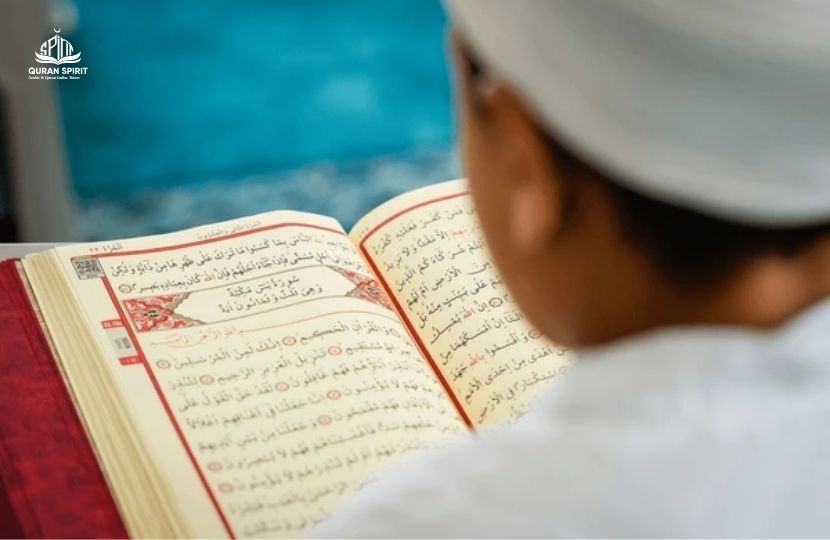
Choosing the right Mushaf is the quiet backbone of successful Quran memorization. When you embark on the sacred journey of Hifdh course, your mind relies heavily on visual memory, mapping verses, page breaks, and diacritical marks to specific positions on a physical page.
Switching layouts mid-journey disrupts this spatial recall, forcing your brain to rebuild its mental map from scratch and making your retention significantly harder. Picking the ideal Mushaf from day one sets a clear, unwavering foundation for effortless and long-term recall.
5 Tips to Choose the Right Mushaf for Hifz
1. Opt for a Standardized Line Layout (15-Line or 16-Line Script)
The layout of the printed page plays a massive role in how predictably you can structure your daily memorization routine.
- The 15-Line Madani Standard: Globally recognized as the standard for memorization, the 15-line print is formatted with complete mathematical precision. Every single page begins at the start of an ayah and ends neatly at the end of an ayah. Furthermore, every Juz (para) spans exactly 20 pages. This uniformity allows you to set clear daily targets, calculate exact page counts, and maintain a consistent pace.
- The 16-Line Indo-Pak Standard: Widely popular across South Asia and among students trained in the Indo-Pak tradition, the 16-line script offers similar structural predictability, with standardized page endings that aid mental tracking.
By selecting a standardized line layout, you eliminate awkward mid-page ayah splits, allowing your brain to associate the top, middle, and bottom of every page with precise verses.
2. Prioritize Font Clarity and Paper Contrast
Quran memorization requires hours of close visual focus every single day. The physical quality of your Mushaf directly impacts your endurance and focus during long revision sessions.
- Clear, Uncluttered Typography: Choose a print with bold, well-spaced Arabic lettering. Avoid decorative fonts, overly dense script, or editions crowded with excessive marginal commentaries and translation notes, as these create unnecessary visual noise.
- High Contrast, Low Glare: Crisp black ink printed on off-white, cream, or light pastel paper is significantly easier on the eyes than high-gloss, stark white paper. Bright white paper reflects light and causes glare, leading to eye strain and headaches during extended study sessions.
- Minimalist Color-Coding: While color-coded Tajweed rules can be helpful for beginners, ensure the colors are subtle. Oversaturated or rainbow-colored text can distract your eyes from the actual shape and sequence of the words.
3. Choose the Script Style That Matches Your Natural Reading Habit
Arabic scripts vary by region and educational background. For Hifdh, you should always choose the script you are already comfortable reading fluently.
- Uthmani / Madani Script: The standard script used across the Middle East and in most modern international Quran institutes. It features minimal diacritical marks, encouraging a smooth flow if you are accustomed to classical Arabic phonetics.
- Indo-Pak / Persian Script: Commonly used across South Asia and surrounding regions. It includes distinct diacritical symbols—such as explicit jazm, tanween, and pronoun indications—that help non-Arabic speakers pronounce text accurately and prevent subtle vowel mistakes during memorization.
Never try to learn a new script style at the same time you are trying to memorise. Stick to the script that requires zero hesitation when reading aloud.
4. Commit to ONE Single Print Edition for Life
This is perhaps the most critical rule of Quran memorization: Once you choose your Mushaf, do not switch.
Your brain creates a photographic memory of the page as you memorize. Over time, you will naturally recall whether a verse was located on the top-left, bottom-right, or middle of a specific page. If you switch to a different print edition—even one with the same number of lines—the spacing and line breaks will differ, confusing your visual memory and triggering hesitation during recitation.
- Buy Multiple Copies: Purchase two or three identical physical copies from the exact same publisher. Keep one at home, one in your daily bag, and one at your local mosque or school.
- Sync Your Digital Edition: If you use a phone or tablet for revision while traveling, download a high-resolution PDF scan of that same physical print edition.
5. Select a Mushaf with Functional Margins
As your memorisation progresses, you will frequently encounter similar verses across different Surahs (mutashabihat). Having space on the page to make subtle study notes is invaluable.
Select a Mushaf with moderate margin space around the text block. This allows you to lightly pencil in cross-references for similar verses, note personal pauses, or record teacher corrections without cluttering or obscuring the Quranic text itself.
Conclusion
Selecting your Mushaf is not merely buying a book—it is choosing the visual blueprint your mind will reference for the rest of your life. By choosing a high-quality, clearly printed edition that fits your reading background and sticking with it faithfully, you allow visual familiarity to work in your favor, unlocking stronger retention and greater confidence throughout your Hifdh journey.
At Quran Spirit, our online quran classes help students build strong memorization habits by choosing a high-quality, clearly printed Mushaf and using the same copy consistently. This visual familiarity strengthens memory, improves retention, and builds confidence throughout their Hifdh journey.
