
Surah Al-Inshiqaq, the 84th surah of the Holy Qur’an, was revealed in Makkah to the Prophet Muhammad (S.a.w.) before his migration to Al-Madinah Al-Munawwarah. (Al-Tahrir and Al-Tanweer by Ibn Ashour, vol. 31, p. 217)
It has 25 ayahs, and it can be found in the 30th Juz, or 59th Hizb, in the Qur’an. At the end of the 21st ayah of this surah, there is a Sajdah At-Tilawat, where, after reciting, is it recommended to perform prostration towards the Qiblah in a state of wudu.
The Reason for the Revelation of Surah Al-Inshiqaq
Many Muslim scholars have been deeply concerned with trying to understand the Qur’an and all its supporting traditions, including investigating the reasons for revelation. One of the most famous Muslim researchers in this field was Al-Waahidi with his book Asbab Al-Nuzul, in addition to As-Suyuti, with his book, Libab Al-Naqul fi Asbab Al-Nuzul. Neither of them found a specific reason for the revelation of Surah Al-Inshiqaq, nor any of its verses. This is not unusual, as not every surah has an apparent reason for its revelation. Some surahs and verses were revealed for several purposes without being linked to a particular situation that necessitated their revelation.
Reading the meaning of Surah Al-Inshiqaq, it becomes clear that an inspiration behind the revelation of this Surah is to illuminate the serious consequences of the Day of Judgement. The destruction of our universe is illustrated with the strong imagery of the sky bursting open and the Earth spilling out its contents.
It then warns people that miserable consequences await those who arrogantly and persistently deny Allah’s existence. The consequences of painful and everlasting fire. However, the surah ends with a hope-inspiring reminder for Muslims that those who believe in Allah and make efforts to do good deeds will be rewarded in the Hereafter forever.
surah al inshiqaq mishary al afasy
Why is This Surah Called Al-Inshiqaq?
The names of the surahs were well-known at the time of the Prophet Muhammad (S.a.w.). There are many hadiths that indicate that those names were common during that time.
For instance, some Sahabah were praying at night with Abu Hurayrah (R), and he was asked by Abu Rafi’ (R) why he prostrated while reciting Surah Al-Inshiqaq, which he referred to using the first ayah. To which Abu Hurayrah (R) replied that it was because the Prophet Muhammed (S.a.w.) had prostrated like that for this surah (Sunan Abu Dawud 1408). This hadith is evidence that the Sahabah referred to this surah by the words from its first ayah and that it is sunnah to prostrate in this surah. Therefore, the names of the surahs are derived from what was revealed and not from the ijtihad of Muslim jurists.
Twenty-one surahs are named based on the first word of the surah, such as Surah Taha. Forty-three surahs’ names came from a word found in the first ayah, such as Surah Al-Isra, in addition to Surat Al-Inshiqaq. Whereas four surahs get their names from the last ayah, like Surah An-Nas. And forty-seven surahs got their name from within the surah, like Surah Al-Baqarah.
The surah is commonly called “Al-Inshiqaq” because it is from the last word in the first ayah, the verb “anshaqqat.” The surah can also be referred to as “Surat Al-Inshiqaq”, “Surat Inshaqqat”, and “Surat Idha as-Samaa’unshaqat.” (Al-Tahrir and Al-Tanweer, Part 30, pg. 193)
“When the sky bursts open.” (Surah Al-Inshiqaq, Ayah 1)
Where the root verb in Arabic means to burst or split. In this ayah, this word refers to the bursting of the sky, which will occur at the beginning of the Day of Judgement. (Quranic Encyclopedia, Characteristics of the Surahs, Part 11, p. 153)
What is the Main Theme of Surah Al-Inshiqaq?
The main theme of Surah Al-Inshiqaq is that the friends of Allah will be blessed on the Day of Judgement and the enemies of Allah will be suffering on the Day of Judgement for their disbelief, stubbornness, and lack of belief in the Resurrection or being accountable with Allah.
Allah, the Almighty said: “When the sky bursts open, obeying its Lord as it must, and when the earth is flattened out, and ejects all its contents and becomes empty, obeying its Lord as it must.” (Surah Al-Inshiqaq, Ayah 1-5)
The verses after that talk about the person who works hard for the sake of their livelihood and strives to get their sustenance. Then at the end of their life, they will either be tormented or rewarded in the Hereafter, according to the deeds that they have earned for themself in this world.
“O humanity! Indeed, you are laboring restlessly towards your Lord, and will [eventually] meet the consequences. As for those who are given their record in their right hand, they will have an easy reckoning, and will return to their people joyfully.” (Surah Al-Inshiqaq, Ayah 6-9)
The next ayahs discuss the attitude of the polytheists towards the Qur’an, as they deny the ayahs of Allah. The ayahs confirm that their sad fate on the Day of Judgement will be a severe punishment from Allah because of their denial and unbelief.
“And as for those who are given their record [in their left hand] from behind their backs, they will cry for [instant] destruction and will burn in the blazing Fire. For they used to be prideful among their people, thinking they would never return [to Allah] […] So, what is the matter with them that they do not believe, and when the Quran is recited to them, they do not bow down [in submission]? In fact, the disbelievers persist in denial. But Allah knows best whatever they hide.” (Surah Al-Inshiqaq, Ayah 10-14, 20-23)
The surah is concluded by reprimanding the polytheists on their lack of faith in Allah and giving them the bad news of painful punishments, with the final ayah sending good news to the Muslims that they have a great reward waiting for them from Allah.
“So, give them news of a painful punishment. But those who believe and do good will have a never-ending reward.” (Surah Al-Inshiqaq, Ayah 24-25)
Advice on How to Memorize Surah Al-Inshiqaq
The memorization of a surah from the Qur’an depends on understanding the meanings of the words and understanding the explanation of the entire surah. Therefore, the Qur’an’s Hafidh is advised to read the Tafseer of the surah beforehand and to memorize it with understanding. Also, it is necessary to contemplate its meanings and understand what the verses refer to, as some ayahs of the Qur’an are more metaphorical than literal.
This is the wisdom behind why Umar (R) took twelve years to memorize Surah Al-Baqarah. (Shu’ab Al-Iman – Al-Bayhaqi [3/346])
If anyone wants to memorize any surah of the Qur’an, they should seek help with the following:
1- Seek Allah’s help and make du’a and ask Him for help in memorizing His Book.
2- Setting and renewing the intention to memorize the Book of Allah Almighty.
3- Understand, contemplate, and know the interpretation of the verses that are intended to be memorized
4- Read the first ayah out loud, from the book, at least 5 times, then try to recite it 5 times by not looking. Then read the second ayah out loud 5 times, then recite it 5 times by not looking. Then read the two ayahs together out loud 5 times, then recite the two ayahs together 5 times without looking. Then read the third ayah 5 times out loud from the book, then recite it from your memory 5 times. After that, read the three ayahs together 5 times, then recite the three ayahs without looking 5 times, and so on until the end of the surah.
5- To make sure that you have saved the surah from your short-term memory into your long-term memory, it is essential that you read it once a day for at least the next 5 days in a row.
6- Keep a revision schedule, where you revise it once at least every ten days.
In sha Allah, using the above as a guide, you can memorize Surah Al-Inshiqaq and understand some of its beautiful wisdom. Allow this surah to be a part of your life and remember that with every effort you make, striving towards doing good for the sake of Allah, you will be rewarded with being in the beautiful and peaceful Jannah forever.
surah inshiqaq read online
surah al inshiqaq hadith
Yahya related to me from Malik from Abdullah ibn Yazid, the mawla of al Aswad ibn Sufyan, from Abu Salama ibn Abd ar Rahman that Abu Hurayra recited al-Inshiqaq (Sura 84) to them and prostrated in it. When he had finished he told them that the Messenger of Allah, may Allah bless him and grant him peace, had prostrated in it.
Narrated Abu Rafi’:I offered the night prayer behind Abu Hurairah. He recited Surah Inshiqaq (“When the sky is rent asunder”) and prostrated himself. I asked him: What is this prostration? He replied: I prostrated myself on account of this (surah) behind Abu al-Qasim (i.e. the Prophet). I shall continue prostrating on account of this till I meet him.Grade: Sahih (Al-Albani)
surah al inshiqaq English translation
- When the sky is rent asunder,
- And hearkens to (the Command of) its Lord, and it must needs (do so);-
- And when the earth is flattened out,
- And casts forth what is within it and becomes (clean) empty,
- And hearkens to (the Command of) its Lord,- and it must needs (do so);- (then will come Home the full reality).
- O thou man! Verily thou art ever toiling on towards thy Lord- painfully toiling,- but thou shalt meet Him.
- Then he who is given his Record in his right hand,
- Soon will his account be taken by an easy reckoning,
- And he will turn to his people, rejoicing!
- But he who is given his Record behind his back,-
- Soon will he cry for perdition,
- And he will enter a Blazing Fire.
- Truly, did he go about among his people, rejoicing!
- Truly, did he think that he would not have to return (to Us)!
- Nay, nay! for his Lord was (ever) watchful of him!
- So I do call to witness the ruddy glow of Sunset;
- The Night and its Homing;
- And the Moon in her fullness:
- Ye shall surely travel from stage to stage.
- What then is the matter with them, that they believe not?-
- And when the Quran is read to them, they fall not prostrate,
- But on the contrary the Unbelievers reject (it).
- But Allah has full knowledge of what they secrete (in their breasts)
- So announce to them a Penalty Grievous,
- Except to those who believe and work righteous deeds: For them is a Reward that will never fail.
surah al inshiqaq roman
- Izas samaaa’un shaqqat
- Wa azinat li Rabbihaa wa huqqat
- Wa izal ardu muddat
- Wa alqat maa feehaa wa takhallat
- Wa azinat li Rabbihaa wa huqqat
- Yaaa ayyuhal insaanu innaka kaadihun ilaa Rabbika kad han famulaaqeeh
- Fa ammaa man ootiya kitaabahoo biyameenih
- Fasawfa yuhaasab hisaabany yaseeraa
- Wa yanqalibu ilaaa ahlihee masrooraa
- Wa ammaa man ootiya kitaabahoo waraaa’a zahrih
- Fasawfa yad’oo thubooraa
- Wa yaslaa sa’eeraa
- Innahoo kaana feee ahlihee masrooraa
- Innahoo zanna an lany yahoor
- Balaaa inna Rabbahoo kaana bihee baseeraa
- Falaaa uqsimu bishshafaq
- Wallaili wa maa wasaq
- Walqamari izat tasaq
- Latarkabunna tabaqan ‘an tabaq
- Famaa lahum laa yu’minoon
- Wa izaa quri’a ‘alaihimul Quraanu laa yasjudoon (make sajda)
- Balil lazeena kafaroo yukazziboon
- Wallaahu a’lamu bimaa yoo’oon
- Fabashshirhum bi’azaabin aleem
- Illal lazeena aamanoo wa ‘amilus saalihaati lahum ajrun ghairu mamnoon
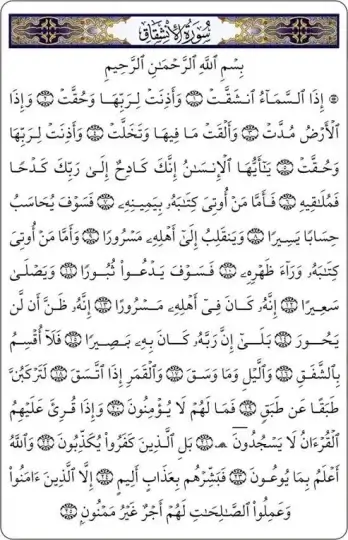
surah al inshiqaq Arabic text
1. إِذَا السَّمَاءُ انْشَقَّتْ
2. وَأَذِنَتْ لِرَبِّهَا وَحُقَّتْ
3. وَإِذَا الْأَرْضُ مُدَّتْ
4. وَأَلْقَتْ مَا فِيهَا وَتَخَلَّتْ
5. وَأَذِنَتْ لِرَبِّهَا وَحُقَّتْ
6. يَا أَيُّهَا الْإِنْسَانُ إِنَّكَ كَادِحٌ إِلَىٰ رَبِّكَ كَدْحًا فَمُلَاقِيهِ
7. فَأَمَّا مَنْ أُوتِيَ كِتَابَهُ بِيَمِينِهِ
8. فَسَوْفَ يُحَاسَبُ حِسَابًا يَسِيرًا
9. وَيَنْقَلِبُ إِلَىٰ أَهْلِهِ مَسْرُورًا
10. وَأَمَّا مَنْ أُوتِيَ كِتَابَهُ وَرَاءَ ظَهْرِهِ
11. فَسَوْفَ يَدْعُو ثُبُورًا
12. وَيَصْلَىٰ سَعِيرًا
13. إِنَّهُ كَانَ فِي أَهْلِهِ مَسْرُورًا
14. إِنَّهُ ظَنَّ أَنْ لَنْ يَحُورَ
15. بَلَىٰ إِنَّ رَبَّهُ كَانَ بِهِ بَصِيرًا
16. فَلَا أُقْسِمُ بِالشَّفَقِ
17. وَاللَّيْلِ وَمَا وَسَقَ
18. وَالْقَمَرِ إِذَا اتَّسَقَ
19. لَتَرْكَبُنَّ طَبَقًا عَنْ طَبَقٍ
20. فَمَا لَهُمْ لَا يُؤْمِنُونَ
21. وَإِذَا قُرِئَ عَلَيْهِمُ الْقُرْآنُ لَا يَسْجُدُونَ ۩
22. بَلِ الَّذِينَ كَفَرُوا يُكَذِّبُونَ
23. وَاللَّهُ أَعْلَمُ بِمَا يُوعُونَ
24. فَبَشِّرْهُمْ بِعَذَابٍ أَلِيمٍ
25. إِلَّا الَّذِينَ آمَنُوا وَعَمِلُوا الصَّالِحَاتِ لَهُمْ أَجْرٌ غَيْرُ مَمْنُونٍ
